Inside the tincture · KUZŪ by Pure Bhutan
Two mushrooms.
One considered ritual.
The body is our first home. Caring for it begins with knowing what we choose—and respecting the people and places that make that choice possible.
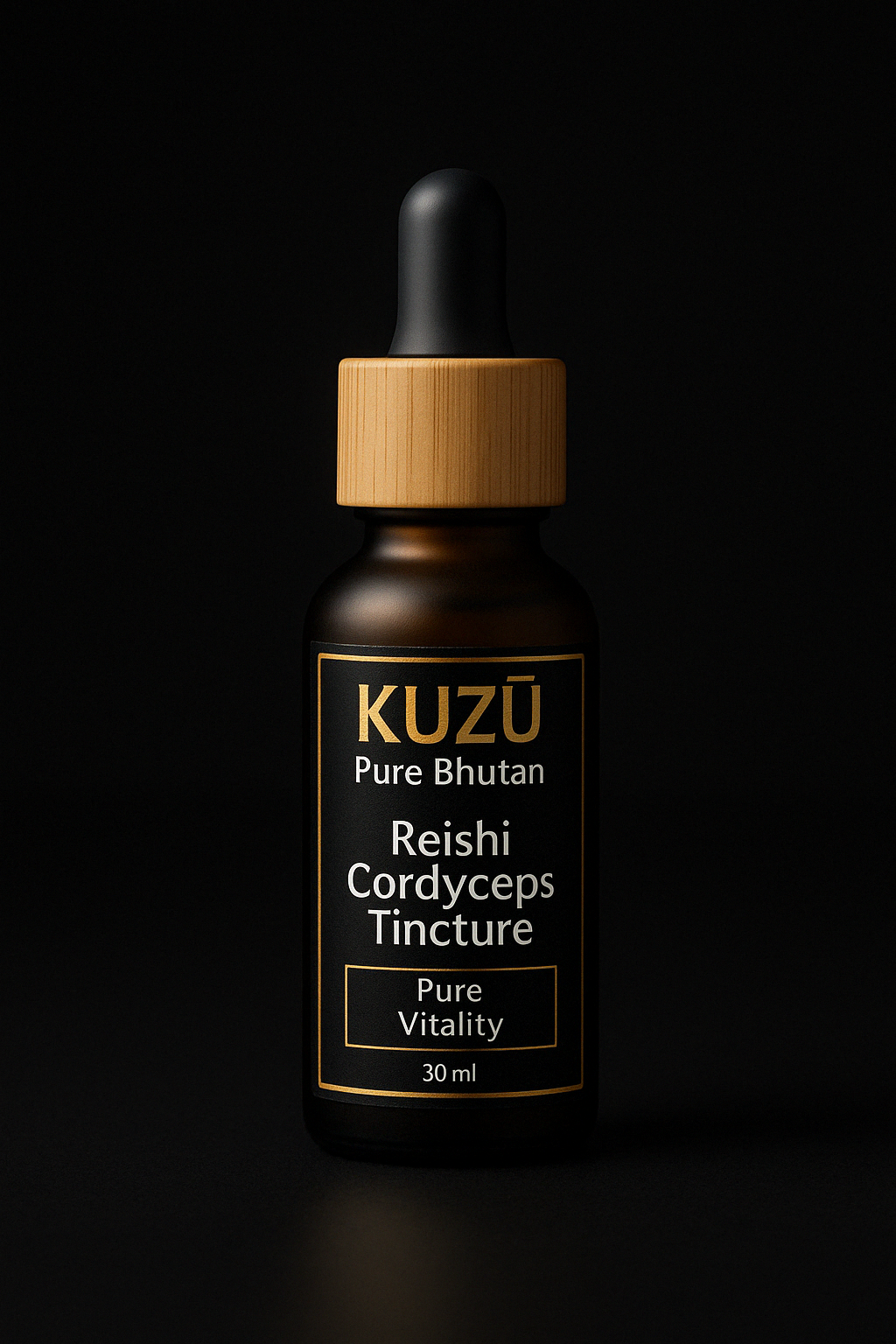
Meet our Reishi Cordyceps Sinensis tincture through its ingredients, the questions behind its formulation, and the relationships behind its origin.
Shop the tincture$111.00 USD
01 · The formulation
A choice rooted in relationship.
Examined through research.
We bring these two fungi together as an expression of Bhutan’s farm and highland sourcing relationships. That is our formulation story. Scientific evidence helps us examine it with care; it does not establish that combining them produces a greater effect.
From the farm.
Reishi connects this ritual to the work of Dambar Gurung and his farming community. Research on Ganoderma lucidum examines compounds including polysaccharides and triterpenoids, and how different preparations recover them.
The meaningful question is not simply “does it contain Reishi?” It is which material was used, how it was prepared, and what was measured in the resulting extract.
Explore the extraction research →From the highlands.
Our Cordyceps relationship begins with Dorji Wangchuk in Gasa and the highland foragers he represents. The source community is part of our understanding of the ingredient, alongside its identity and preparation.
A study of cultured Cordyceps or a different species cannot automatically describe a wild-sourced ingredient. Our approach is to connect research to the actual material, rather than promise benefits from the name alone.
Meet the people behind the ingredients →The research below does not establish clinical benefits or synergy for the finished KUZŪ tincture. A thoughtful formulation also means being clear about what remains unproven.
02 · Care in preparation
Extraction is a question
of intention and measurement.
Our aim is to make considered use of each ingredient. “Maximum benefit” cannot be read from an extraction ratio alone: the starting material, solvent, conditions and finished-product measurements all matter.
Know the material.
Species, plant or fungal part, source and lot identity give a process its starting point. Traceability keeps that context attached to the bottle.
Understand the solvent.
Water and ethanol are used in Reishi extraction research to recover different compound fractions. Solvent composition and process conditions influence what is recovered.
Measure the result.
A process description explains how an extract was made. A batch report explains what a laboratory measured. Neither, on its own, demonstrates a health benefit in people.
The paper linked below studies ultrasound-assisted extraction in a laboratory. It is research context, not verification that KUZŪ uses that method. Consult your bottle’s published process record and current label for product-specific details.
Read the method and its limits →03 · People before ingredients
Origin has a human voice.
These relationships are central to KUZŪ. We introduce the people behind our sourcing in their own roles, without turning a community into a marketing backdrop.
Reishi · Farm and community
Dambar Gurung
Dambar Gurung represents his farm and community in our Reishi sourcing relationship. His place in the KUZŪ story reminds us that an ingredient begins with people, their work and their relationship with the land.
Cordyceps · Gasa highlands
Dorji Wangchuk
Dorji Wangchuk, our Cordyceps supplier from Gasa, represents his community and around 30 fellow highland foragers. Through this relationship, our sourcing story remains connected to the people who gather the ingredient.
A sourcing relationship introduces the people behind KUZŪ. Your batch record identifies the source entries associated with your particular bottle.
04 · Access and benefit sharing
To take with care.
To give with intention.
For KUZŪ, reverence for nature includes reverence for the people who live with it. ABS—Access and Benefit Sharing—asks us to consider who grants access, whose knowledge contributes, and how benefits are shared.
We value this framework because it turns respect into questions that must be answered together. What is the purpose of access? What has been agreed? How can the relationship create meaningful value for the people and places behind an ingredient?
Begin with permission.
Access is a relationship to enter thoughtfully, with the appropriate consent and a clear purpose.
Agree on shared value.
Benefit sharing can involve monetary and non-monetary terms. The actual agreement, rather than a general promise, defines the commitments.
Show the boundaries.
Dates, covered resources and permitted uses make an agreement understandable. Our environmental intentions should be accompanied by evidence of outcomes as it becomes available.
Read our Reishi ABS record and its scope
ABSCH-IRCC-BT-280228-1 names Pure Bhutan and Goenshari Zhelngosa Ganoderma Detshen, with prior informed consent and mutually agreed terms recorded for Reishi tincture development.
- Validity stated in the supplied record
- 11 April 2025–10 April 2030
- Allowed use
- Non-Commercial
- Resource
- Ganoderma lucidum (Reishi)
This record does not establish commercial authorization or coverage for Cordyceps. It is not a purity, safety or efficacy certification for the finished tincture.
View the public ABS record ↗05 · From story to a specific bottle
Your code.
Your origin record.
Find the four-character code on your bottle or box. A code such as A001 connects a published batch to its available source, production and evidence records.
Look for named source communities, harvest and production dates, laboratory report identifiers, the sample tested and the scope of any agreement. A report belongs to a particular sample and date; it is not a promise about every bottle ever made.
Trace your originOnly published records are searchable. If your code has no available record, contact us with the code using the contact details on your bottle.
06 · Read the evidence
Research, with its context intact.
We link to peer-reviewed work so you can examine the preparation, study design and findings yourself. These papers inform questions about ingredients and methods; they do not confirm benefits of KUZŪ’s finished formulation.
Reishi, Cordyceps and metabolic risk
Klupp and colleagues studied 84 people with type 2 diabetes and metabolic syndrome over 16 weeks. The study found no significant improvement in its measured cardiovascular risk factors with Reishi, with or without Cordyceps. The intervention groups were combined for analysis.
What this means: this study does not support claims that KUZŪ improves blood sugar or cardiovascular health, or that the two mushrooms act synergistically.
Klupp et al. · Scientific Reports · DOI 10.1038/srep29540 ↗How preparation changes an extract
Zheng and colleagues examined ultrasound-assisted extraction of Reishi polysaccharides and triterpenoids using aqueous ethanol. They measured extraction yields and antioxidant activity in laboratory assays.
What this means: process conditions matter. The study does not demonstrate human absorption, clinical benefits or the performance of KUZŪ’s production method.
Zheng et al. · PLOS ONE · DOI 10.1371/journal.pone.0244749 ↗For ingredients, directions, alcohol content and warnings, read the current product label before choosing or using the tincture. Laboratory measurements, traditional use and clinical research answer different questions.
Honor the body.
Know what you choose.
Respect your KUZŪ.